Hola, I'm Chris.
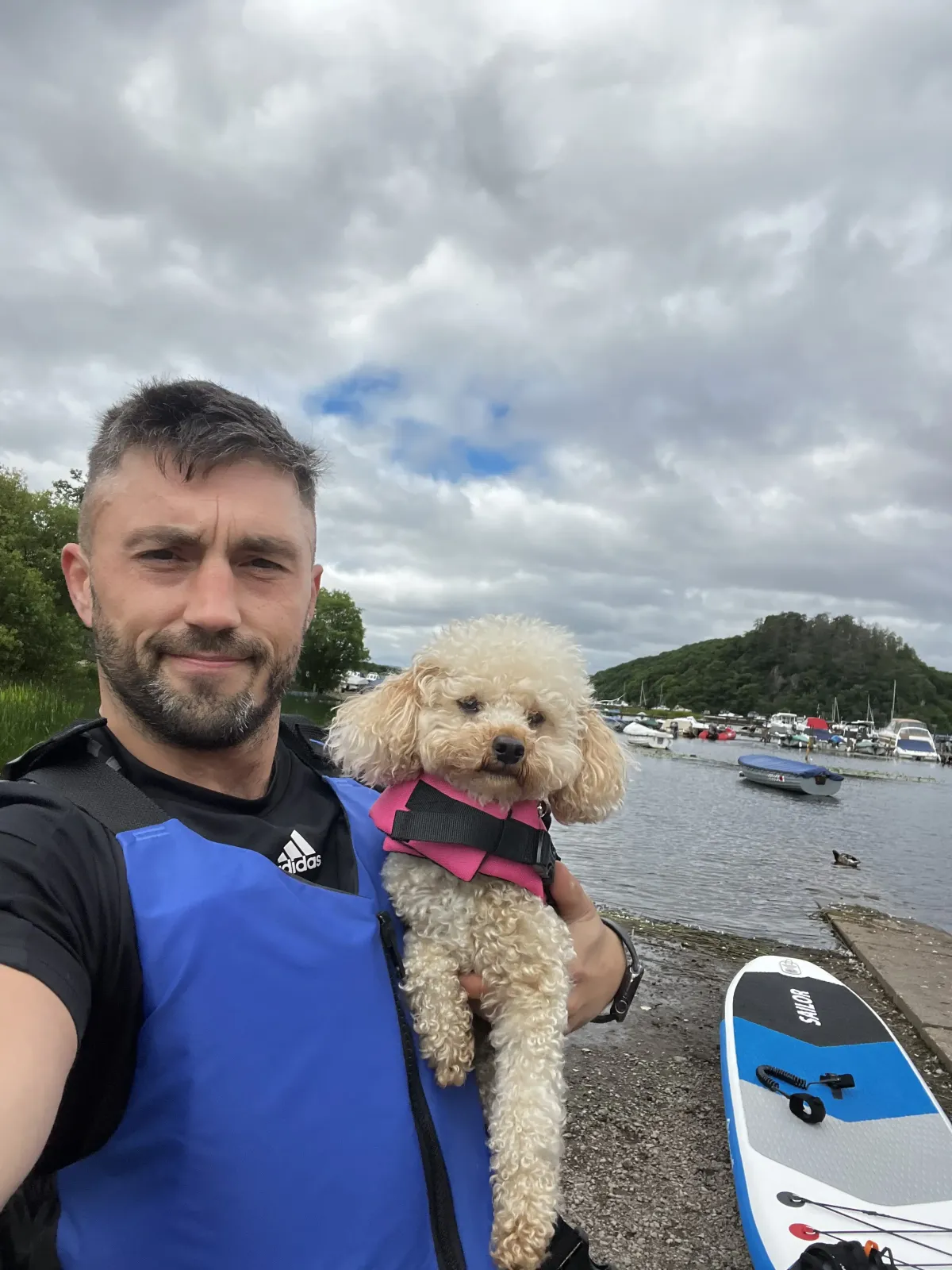
You'll usually find me and Latte in a coffee shop, watching the world go by.
You've probably spent years trying to fix something that was never broken.
The diets, the programmes, the fresh starts that lasted three weeks. The mornings you stood on the scale and let a number decide how the rest of your day went. The feeling that everyone else has figured something out that you just can't quite get to.
If any of that sounds familiar, you're in the right place - and I want you to know that I'm not saying that lightly.
I know what it feels like to be at war with your own body. Not in a theoretical way. In a lived-it, can't-get-out-of-it way.
When I was a kid, something happened to me that I won't go into in full detail here, but it involved being humiliated in front of a group of people in a way that left a mark I carried for years. The nicknames started around the same time. Fast Food Freddy. Pugsley. Brucie Bogtrotter. Kids are brutal!
By the time I was 13, I was drinking and taking drugs regularly (I know, madness) - not because I wanted to, but because it was the only way I knew how to feel comfortable in my own skin and be able to speak to people. Confidence from a bottle, because I had no idea how to find it anywhere else.
I first walked into a gym at 18 and spent the next nine years going round in circles - a few months on, a few months off, never quite able to make it stick. I took steroids twice. Once at 18 to fit in with the people around me, and again in my mid-twenties when I was living in Tenerife, surrounded by tall, dark, handsome spanish dudes.
I tried everything I could think of to change how I looked, because changing how I looked felt like the only solution to how I felt. It never worked, because it was never the real problem.
What changed wasn't a programme or a plan. It was the slow realisation, during lockdown, that I had spent my entire life trying to fix the outside without ever touching the inside.
The gym helped - genuinely helped my head - but only when I stopped chasing a six pack and started using it for my mental health, my strength, and the person I was trying to become.
I don't know exactly why women started finding their way to me as clients, but they did, right from the beginning. My first ever client was a woman named Karen in her late forties with cervical spondylitis who could barely move her neck.
Since then it's been women with chronic pain, women managing depression, women with gut problems and sciatica and injuries they'd been told to just live with. Women who had been let down by systems that weren't designed with them in mind.
I think part of it is my mum. She struggled for years with her health and never got the support she deserved.
I believe, genuinely, that if she'd had the right guidance - the right combination of strength training, nourishment, and someone actually listening to her - rather than just adjusting her epilepsy medication and hoping for the best - things might have been different. She died at 60.
That stays with me every single day, it honestly kills me, and it's a big part of why I do this work with the commitment that I do.
What I've learned, from my own story and from the women I've worked with over the years, is that the body is almost never the real problem. The real problem is the story we've been told about it - and the story we've started telling ourselves.
My job isn't to give you a plan and leave you to it. It's to help you change the relationship you have with your body, your food, and yourself, so that whatever progress you make actually sticks.
You deserve to feel strong. You deserve to feel settled. And you deserve to feel at peace with yourself - not when you hit a number, but now, while you're doing the work.
That's what this is about.
If any of this sounds familiar, I'd love to have a chat.
Qualified personal trainer, certified nutrition coach, certified mental health coach and N1-biomechanics coach.